
1. บทนำ
The Radxa Penta SATA HAT is an expansion board designed to provide up to five SATA disk interfaces for compatible Single Board Computers (SBCs), including the Raspberry Pi 5 and various Radxa ROCK SBCs. This HAT enables the creation of compact Network Attached Storage (NAS) servers or other storage-intensive projects, supporting up to 100TB of storage capacity. It features four standard SATA ports and one eSATA port with power, offering flexible storage solutions.
2. สินค้าหมดview
The Penta SATA HAT integrates essential components for multi-drive storage. Key features include:
- SATA Interfaces: 4x SATA ports and 1x eSATA port with power.
- ความจุในการเก็บข้อมูล: Supports up to 100TB total storage.
- ตัวเลือกพลังงาน: External Standard ATX Power Supply interface or 12V DC Power Supply input.
- ความเข้ากันได้: Designed for Raspberry Pi 5 and Radxa ROCK SBCs.
- การขยายตัว: Includes interfaces for OLED display and fan.
ภาพ: เหนือview of the Radxa Penta SATA HAT highlighting its key features and interfaces.
3. อะไรอยู่ในกล่อง
ตรวจสอบว่าแพ็คเกจของคุณมีส่วนประกอบทั้งหมดต่อไปนี้:
- Penta SATA HAT board
- สาย FPC
- Copper Posts (for mounting)
- eSATA Cable
- Acrylic Board (for protection/enclosure)
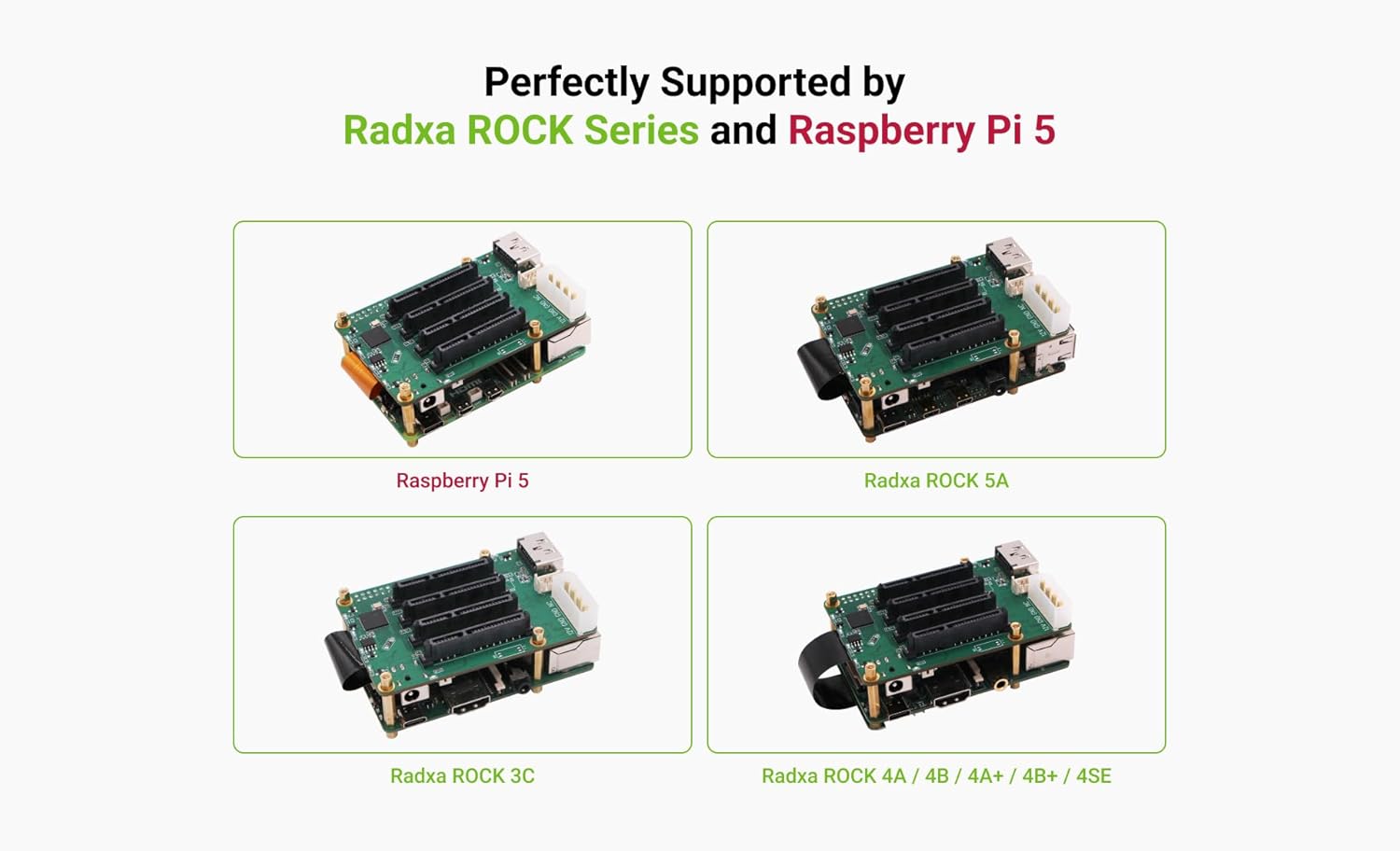
Image: All components included with the Radxa Penta SATA HAT, including the HAT board, FPC cable, copper posts, eSATA cable, and acrylic board.
4. คำแนะนำในการตั้งค่า
Follow these steps to set up your Radxa Penta SATA HAT with your compatible SBC.
4.1. การระบุส่วนประกอบ

ภาพ: ด้านบน view of the Radxa Penta SATA HAT, showing the location of 4x SATA ports, eSATA port, external ATX power supply interface, expansion interface (OLED and Fan), and 12V DC input.
4.2. การตรวจสอบความเข้ากันได้
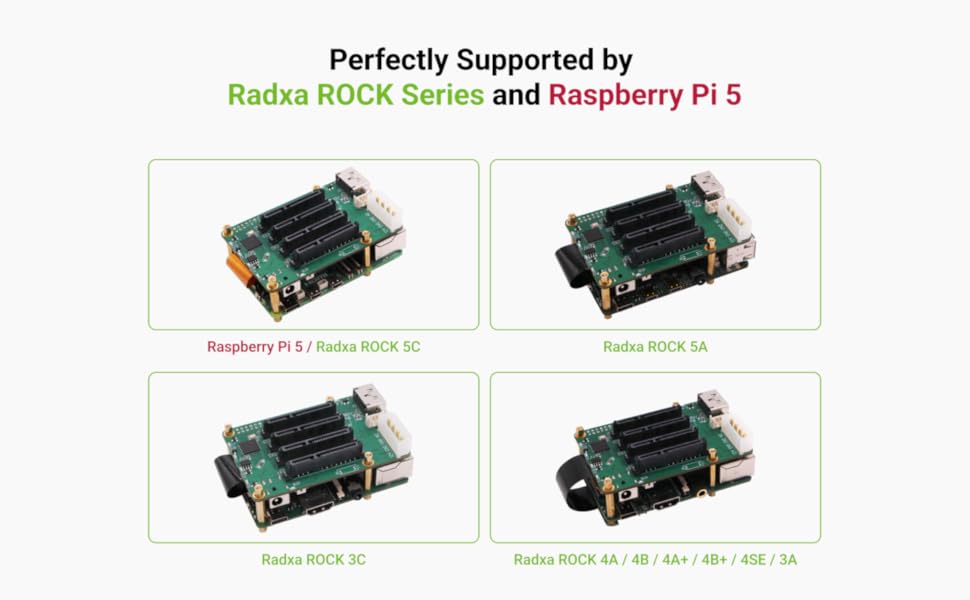
Ensure your Single Board Computer is compatible. The Radxa Penta SATA HAT supports Raspberry Pi 5 and various Radxa ROCK series boards.

Image: Visual representation of the Radxa Penta SATA HAT mounted on various compatible SBCs, including Raspberry Pi 5, Radxa ROCK 5A, Radxa ROCK 3C, and Radxa ROCK 4 series.
4.3. การประกอบและการเชื่อมต่อ
- Mount the HAT: Securely attach the Penta SATA HAT to your Raspberry Pi 5 or Radxa ROCK SBC using the provided copper posts.
- เชื่อมต่อสายเคเบิล FPC: Connect the FPC cable between the HAT and your SBC's appropriate connector.
- Connect SATA Drives: Connect your 2.5-inch or 3.5-inch SATA HDDs/SSDs to the 4x SATA ports. For external drives, use the eSATA port with the provided eSATA cable.
- การเชื่อมต่อไฟฟ้า: Connect a 12V DC power supply (recommended 4A or 5A) to the 12V DC jack on the HAT, or connect a standard ATX power supply to the designated interface. สำคัญ: Once the Radxa Penta SATA HAT is powered, it will supply power to the SBC through the 40-pin connector, eliminating the need to power the SBC separately.

Image: Illustration of the flexible power interface options, showing the 12V DC 5525 Power Jack and the Molex 4-Pin Peripheral Power Connector on the Radxa Penta SATA HAT.
4.4. Optional Expansion Connections
The HAT includes an expansion interface designed to support an OLED display and a cooling fan (sold separately).

Image: Close-up of the Radxa Penta SATA HAT showing the dedicated expansion interface for an OLED display and fan.
5. คู่มือการใช้งาน
Once assembled and powered, the Radxa Penta SATA HAT will make the connected SATA drives available to your SBC's operating system, typically Linux.
5.1. การกำหนดค่าซอฟต์แวร์
For optimal performance and data safety, consider configuring your drives in a RAID array. The HAT supports software RAID configurations such as RAID 0, RAID 1, and RAID 5, which can be managed through your Linux operating system.

Image: Diagram illustrating RAID 0, RAID 1, and RAID 5 configurations for data management and redundancy.
5.2. NAS Server Functionality
With the drives configured, you can install NAS software (e.g., OpenMediaVault, TrueNAS SCALE) on your SBC to create a functional network-attached storage server. This allows for centralized file storage, media streaming, and data backup.
6. การบำรุงรักษา
To ensure the longevity and reliable operation of your Radxa Penta SATA HAT and connected components:
- รักษาความสะอาด: Regularly clean the HAT and SBC to prevent dust buildup, which can lead to overheating.
- การระบายอากาศ : Ensure adequate airflow around the HAT and SBC, especially when multiple drives are in use. Consider adding a cooling fan to the expansion interface if temperatures are high.
- การจัดการสายเคเบิล: Keep all cables neatly organized and securely connected to prevent accidental disconnections or damage.
7 การแก้ไขปัญหา
หากคุณพบปัญหา โปรดพิจารณาขั้นตอนการแก้ไขปัญหาต่อไปนี้:
- ไม่พบไดรฟ์:
- Verify all SATA and FPC cables are securely connected to both the HAT and the drives.
- Ensure the HAT is receiving sufficient power from the 12V DC or ATX power supply.
- Check the power connections to individual 3.5-inch HDDs, as they may require separate power if the HAT's supply is insufficient.
- SBC Not Powering On:
- Confirm the 12V power supply is functional and correctly connected to the HAT.
- Ensure the HAT is properly seated on the SBC's GPIO pins.
- If the SBC still does not power on, temporarily remove the HAT and attempt to power the SBC directly to rule out a HAT-related issue.
- ปัญหาความเข้ากันได้:
- While compatible with many Radxa ROCK SBCs, specific models like the Rock5A may require particular cables or adapters not included with the standard HAT package. Verify requirements for your specific SBC model.
8. ข้อมูลจำเพาะ
| ยี่ห้อ | รัดซา |
| หมายเลขรุ่น | Radxa Penta SATA HAT |
| ฮาร์ดแวร์อินเตอร์เฟซ | SATA 3.0 กิกะบิตต่อวินาที |
| ขนาดสินค้า (กว้าง x ยาว x สูง) | 3.27" x 2.17" x 1.26" |
| น้ำหนักสินค้า | 0.17 กิโลกรัม |
| อุปกรณ์ที่รองรับ | Raspberry Pi 5 and ROCK Pi SBCs |
| ระบบปฏิบัติการ | ลินุกซ์ |
9. ข้อมูลการรับประกัน
The Radxa Penta SATA HAT comes with a รับประกัน 1 ปี นับจากวันที่ซื้อสินค้า การรับประกันนี้ครอบคลุมข้อบกพร่องจากการผลิตภายใต้การใช้งานปกติ โปรดเก็บหลักฐานการซื้อไว้เพื่อใช้ในการเรียกร้องการรับประกัน
10. การสนับสนุน
For further assistance, technical support, or to report issues, please refer to the official Radxa website or community forums. Online resources and documentation are often available to help with advanced configurations and troubleshooting.